You’re evaluating interactive video tools for the first time in 2026, and the category is a mess.
Some platforms call themselves “interactive video” but only collect video replies. Others lock you into Shopify and charge more the more visitors land on your pages. One charges by the minute and locks your content when you exceed a monthly cap. Another requires a consultant and a six-week setup before you see anything live.
Four platforms dominate the conversation. They serve four completely different jobs. Picking the wrong one doesn’t just waste budget. It wastes the quarter.
This roundup breaks down what each platform actually does, who it serves, and what it costs, so you choose based on your workflow, not their marketing page.
Quick Verdict - Four Platforms, Four Categories
The best interactive video funnel platforms in 2026 are Orwix Studio, Tolstoy, VideoAsk, and Life Inside. Orwix Studio leads for marketers who need deep branching logic, AI video generation, and flat-rate pricing. Tolstoy owns Shopify shoppable feeds. VideoAsk handles async HR forms. Life Inside serves enterprise with managed deployment.
The market hasn’t consolidated. It’s fractured.
In 2024, “interactive video” meant one thing: a video with clickable elements. In 2026, that label covers four distinct product categories with almost no overlap. A Shopify merchant looking for TikTok-style product feeds, an HR director screening candidates, an enterprise brand commissioning a bespoke video experience, and a performance marketer building a 15-node qualification funnel are all searching for “interactive video.” They need completely different tools.
The shared frustration across all four buyer types is pricing architecture. Two of the four major platforms charge based on consumption: Tolstoy bills per impression (your cost rises with your traffic), and VideoAsk bills per processed minute (your cost rises with your engagement). A third, Life Inside, charges enterprise retainers starting at €249/mo with consultant-led setup. Only one, Orwix Studio, charges a flat monthly rate with unlimited views regardless of traffic volume.
That structural difference shapes everything downstream. It determines whether your most successful campaign is your cheapest or your most expensive month.
| Platform | Primary Category | Best For | Pricing Model |
|---|---|---|---|
| Orwix Studio | Meta-Funnel Builder | Branching logic, performance marketing, SaaS, B2B lead gen | Flat rate, 399-950 SEK/mo (~$36-$86), unlimited views |
| Tolstoy | E-commerce Feed Generator | Shopify shoppable video, catalog-scale product feeds | Impression-based, $39-$499+/mo, automatic overage |
| VideoAsk | Async Video Form | HR screening, candidate submissions, async customer feedback | Per-minute processing, $24-$40/mo, minutes expire monthly |
| Life Inside | Enterprise Agency Model | Large organizations with production teams and procurement budgets | Retainer + setup fees, starting at €249/mo |
Four platforms. Four categories. Only one charges a flat rate and works on any website.
What Makes a Video Funnel Platform Worth Using in 2026
A modern interactive video funnel platform needs conditional branching logic, multiple CTA types, lightweight widget rendering, built-in AI video generation, and predictable pricing. Platforms missing two or more of these criteria serve a narrower use case than their marketing pages suggest.
Before reviewing each platform, here’s the rubric. Five criteria separate a funnel builder from a video player with buttons.
1. Conditional branching logic. Can a viewer’s choice at node 3 change what they see at node 8? Can different branches trigger different CTAs? If the platform only supports linear playback with clickable overlays, it’s a video player, not a funnel builder.
2. CTA variety. A “Buy Now” button and a contact form aren’t enough. Performance marketers need WhatsApp routing, SMS triggers, conditional promo codes, Shopify product cards, calendar booking, and lead capture, each configurable per funnel node. The more CTA types, the more conversion paths you can test.
3. Widget rendering. How does the platform embed on your site? Standard iframes risk layout shift and CSS conflicts. Script injection fights with your theme’s styles. Shadow DOM encapsulation isolates the widget at the browser level. The embed method directly affects your Core Web Vitals scores, and Google confirmed CWV as a ranking signal in 2021.
4. AI video generation. Branching funnels need multiple videos, one per path. If the platform requires you to record every video yourself or subscribe to a separate AI tool, production becomes the bottleneck. Native AI avatars, image-to-video, and script humanization collapse the production stack into the builder itself.
5. Predictable pricing. Usage-based billing (per impression or per minute) creates a perverse incentive: your best-performing campaigns cost the most. Flat-rate pricing decouples software cost from marketing performance. Your CFO can forecast the line item without guessing next month’s traffic.
Interactive video funnels command an average 18% conversion rate compared to 3% for passive video, a 500% improvement (ClickForest, 2026). But that lift only materializes when the platform supports real interaction, not just playback with a button overlay.
Each platform reviewed below scores differently against these five criteria. The profiles explain why.
Orwix Studio - The Flat-Rate Meta-Funnel Builder
Orwix Studio is a flat-rate interactive video funnel builder with 10 CTA types, conditional branching via The Studio, Shadow DOM rendering, and built-in AI video generation. Pricing starts at 399 SEK/mo (~$36) with unlimited views. No per-impression billing. No per-minute billing. Works on any website.
Core Features and Builder Experience
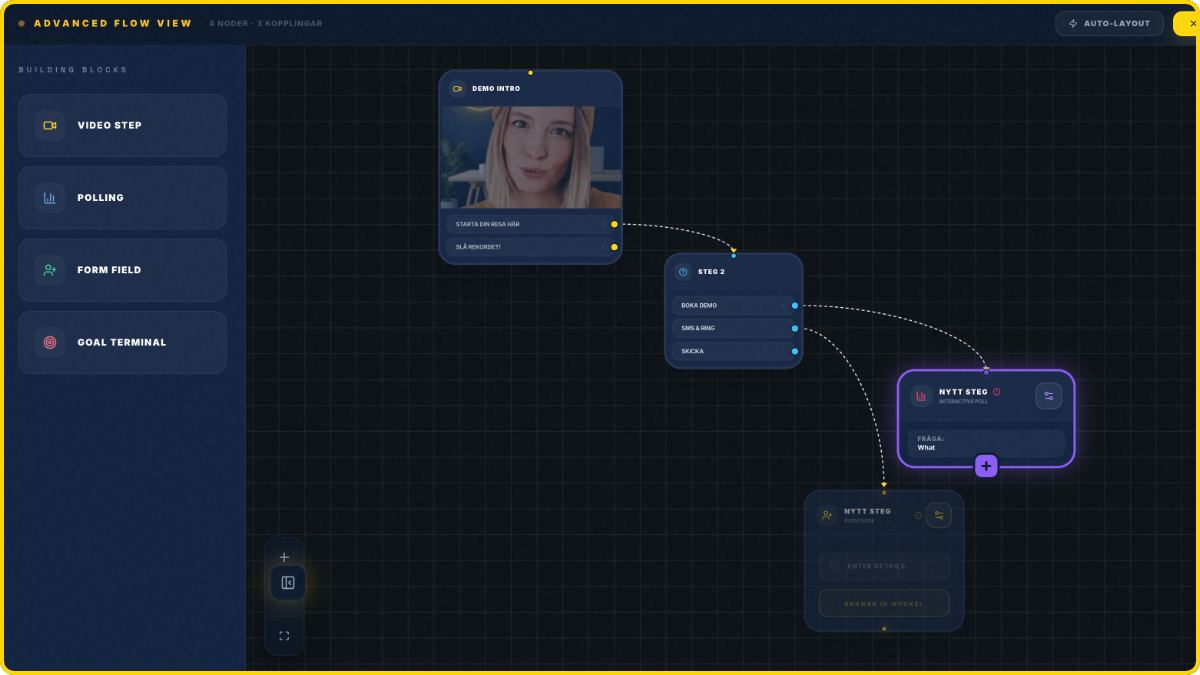
The Studio is a visual, node-based funnel builder. You see the entire decision tree on one screen, drag connections between nodes, set if/then conditions, and configure different CTAs at different points in the flow. It works identically on mobile and desktop, full editing parity, not a read-only preview.
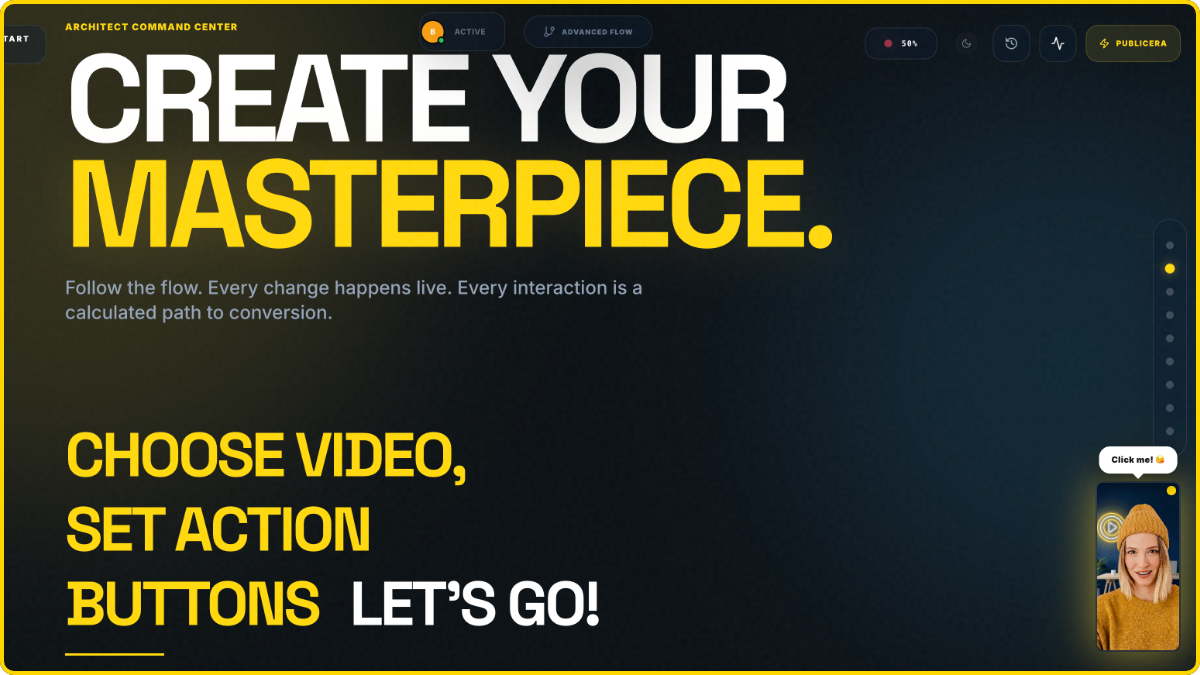
Ten CTA types ship natively:
- Shopify product cards with Add to Cart
- Lead capture forms with custom fields
- Calendar booking integration
- Promo code reveals, conditional on prior viewer behavior
- WhatsApp chat routing, directed to specific agents based on branch selection
- SMS triggers fired on specific node exits
- URL redirects per branch
- Video responses from viewers
- Conditional buttons that change based on earlier choices
- Booking CTAs for service-based businesses
Every CTA is configurable per node. A viewer who selects “enterprise” at node 3 sees a different booking CTA than one who selects “startup.” That conditionality is the difference between a video player and a conversion engine.
The widget renders inside a native Shadow DOM boundary with a compiled Svelte 5 runtime. Styles cannot leak in or out. Zero CSS inheritance, zero z-index conflicts, zero layout shift. The payload stays under 50KB. Your Core Web Vitals scores stay exactly where they were before you installed the widget.
Elephant Memory provides session persistence at the edge via Cloudflare Durable Objects. If a viewer abandons the funnel at node 7 and returns the next day on a different device, Smart Resume picks up at the exact node with previous answers intact. Video playback resumes at the precise millisecond. Cookie clearing doesn’t reset the flow because the state lives on the server.
AI Video Generation and Script Humanization
Branching funnels need content for every path. That’s the production bottleneck most platforms ignore. Wyzowl’s 2024 Video Marketing Statistics Report found that 33% of marketers don’t create video because they lack time and 20% cite cost as the barrier.
Orwix Studio collapses the production stack into the builder. AI avatars generate natively inside the editor. Image-to-video workflows convert static assets into dynamic video. Script humanization rewrites draft scripts using an LLM to sound conversational rather than corporate. The workflow: write the script, humanize it, generate the avatar, drop it into a node, configure the CTA, publish. One platform. One session. No camera required.
Pricing and Who It’s Built For
Two tiers. No consumption metering.
Start costs 399 SEK/mo ($36). One active flow, unlimited views. Pro costs 950 SEK/mo ($86). Five active flows, white-label branding, full branching logic. Still unlimited views.
HubSpot’s 2024 State of Marketing Report found that personalized CTAs convert 202% better than default versions. Orwix gives you 10 CTA types to test that hypothesis across conditional branches, and charges the same amount whether 100 people see your funnel or 100,000.
Best for: Performance marketers, SaaS teams, B2B lead gen, e-commerce operators who need branching funnels on any CMS with predictable monthly costs. Solo operators who build at 6am on a commuter train and ship before lunch.
Not for: Shopify brands that need catalog-scale shoppable feeds synced to hundreds of SKUs (Tolstoy handles that). HR teams collecting candidate video submissions (VideoAsk handles that). Enterprise organizations that prefer managed service over self-serve (Life Inside handles that).
Tolstoy - The Shopify Shoppable Video Engine
Tolstoy is an AI-powered shoppable video platform optimized for Shopify e-commerce brands. It offers catalog-scale product feeds, AI product photography, and virtual try-on. Pricing is impression-based ($39-$499+/mo) with automatic overage billing. Best for Shopify-native D2C brands running shoppable feeds, not general-purpose funnel building.
Shopify Integration and AI Commerce Features
Tolstoy holds the “Built for Shopify” badge, the highest Shopify certification, and claims over 5,000 Shopify brands on the platform. Installation is one click. The app syncs your product catalog automatically, pulling products, orders, and store analytics from your Shopify admin.
The platform runs three product lines. AI Player powers TikTok-style swipeable feeds, stories, carousels, and hero videos on product pages. AI Studio generates catalog-scale product photography and image-to-video content without physical shoots. AI Shopper runs a conversational AI chatbot with virtual try-on for fashion and beauty products.
Tolstoy also powers “Shop Videos” for Shopify’s consumer-facing Shop App, giving merchants a free distribution channel no other platform in this roundup offers. Walmart homepage syndication is available on every tier including free.
For Shopify brands with hundreds of SKUs that need dynamic product feeds, Tolstoy’s catalog integration is the deepest in the category.
Pricing Model and the Impression Ceiling
Tolstoy bills per unique impression. Every time a widget loads for a unique visitor, that counts as a billable impression, regardless of whether the visitor presses play.
- Plus ($39/mo): 5,000 impressions
- Pro ($199/mo): 20,000 impressions
- Max ($499/mo): 50,000 impressions
- Enterprise (custom): 50,000+
Overage billing is automatic. Videos keep serving and charges accumulate without a warning stop. A Trustpilot reviewer (November 2023) reported a 53x discrepancy between their analytics (2,521 visitors) and Tolstoy’s billed page views (134,000). Tolstoy issued a refund but never explained the gap.
At 50,000 monthly visitors, you’re on the $499/mo Max tier. A viral weekend pushes you past the cap and into custom Enterprise pricing.
Where Tolstoy Fits and Where It Doesn’t
Pick Tolstoy if: you run a Shopify store, need shoppable video feeds synced to your catalog, and your traffic stays within a predictable impression range.
Look elsewhere if: you need conditional branching funnels (branching only works on embedded/branching widgets, not feeds, stories, or carousels), you run on a non-Shopify CMS (WooCommerce, Magento, and headless builds require manual CSV catalog uploads), or your traffic spikes unpredictably and you want to avoid surprise invoices.
VideoAsk - The Async Video Form for HR and Support
VideoAsk is an asynchronous video form tool owned by Typeform, built for HR screening, candidate submissions, and customer feedback. Pricing is per-minute ($24-$40/mo) with minutes expiring monthly. No AI video generation, no e-commerce features, and no conditional funnel logic beyond basic branching.
What VideoAsk Actually Does Well
VideoAsk collects video replies. A hiring manager records a prompt. Candidates record responses. The team reviews asynchronously. For HR screening, async customer feedback, and internal communication, this workflow is clean and functional.
Response types include video, audio, multiple choice, text input, NPS rating, basic calendar scheduling, and a single-item Stripe payment link. The Typeform integration is native. If your organization already runs on Typeform for surveys, VideoAsk slots in without middleware.
The Per-Minute Pricing Problem
VideoAsk bills on processing minutes consumed across your account, including every respondent reply.
- Start (Free): 20 minutes/month, heavy branding, max 3 steps
- Grow ($24/mo): 100 minutes/month, partial branding removal
- Brand ($40/mo): 200 minutes/month, full white-label, AI Chatbot access
Minutes expire monthly. A 1-minute prompt receiving 50 two-minute replies burns 101 minutes, breaching the Grow plan in a single campaign. Content locks until you upgrade or the next billing cycle starts. The model works for low-volume HR screening (15 candidates at 3 minutes = 45 minutes, well within Grow). It punishes marketing campaigns where engagement scales unpredictably.
Stagnation Under Typeform
VideoAsk was acquired by Typeform and integrated into their product suite. Since the integration, feature development has visibly slowed. The blog publishes roughly 11 recent posts, targeting HR and recruitment keywords almost exclusively. Product positioning has narrowed from “interactive video for marketing” to “async video for HR and support.”
Capterra reviewers report that “the video size is so limited that many applicants are unable to upload their short videos” (verified Capterra review). A separate reviewer flagged API instability: “The JSON outputs change every 3-4 months, which means I have to do regular maintenance of my code.”
No AI avatar generation. No image-to-video. No script humanization. No e-commerce features. No Shopify integration. No documented session persistence. The widget embeds via standard iframe.
Users actively search “VideoAsk alternatives 2026” citing a need for more flexibility, better pricing, and stronger integrations.
Life Inside - The Enterprise Agency Model
Life Inside is an enterprise interactive video platform with consultant-led setup, starting at €249/mo. Deployment takes weeks, not hours. Best for large organizations with dedicated production teams and procurement budgets. Not a self-serve SaaS for agile marketers or solo operators.
The Managed Service Proposition
Life Inside offers a white-glove interactive video experience. A dedicated team helps you plan, produce, and deploy your video content. The result is polished, brand-controlled, and built to enterprise specifications.
The trade-off is speed and autonomy. You don’t log in and build a funnel in an afternoon. You engage a team, scope the project, produce assets through their workflow, and launch on their timeline. For organizations with quarterly planning cycles and dedicated video production budgets, this is a feature, not a bug. For a solo marketer who needs to test a hypothesis by Friday, it’s a dealbreaker.
Pricing, Timeline, and Who This Serves
Pricing starts at €249/mo (~$270) with setup fees. Public documentation on exact tier structures is limited, which is itself a signal: if you need to ask for pricing, the product expects a procurement conversation, not a credit card.
Deployment timelines run in weeks. The product suits enterprise marketing departments, large B2B organizations, and brands that commission video content through agencies.
If deploying your interactive video takes six weeks, it’s not software. It’s a service. That’s not a criticism. It’s a category distinction. Some buyers want managed service. Most marketers in 2026 want to ship.
Head-to-Head Comparison: All 4 Platforms
This table compares Orwix Studio, Tolstoy, VideoAsk, and Life Inside across pricing, branching logic, CTA types, AI generation, widget tech, e-commerce, session persistence, and deployment speed for interactive video funnel buyers in 2026. All data reflects publicly available information as of March 2026.
| Criteria | Orwix Studio | Tolstoy | VideoAsk | Life Inside |
|---|---|---|---|---|
| Category | Meta-Funnel Builder | E-commerce Feed Generator | Async Video Form | Enterprise Agency Model |
| Pricing model | Flat rate, unlimited views | Per impression, automatic overage | Per minute, minutes expire monthly | Retainer + setup fees |
| Entry price | 399 SEK/mo (approx $36) | $39/mo (5K impressions) | $24/mo (100 minutes) | €249/mo (approx $270) |
| Conditional branching | Full if/then via The Studio | Basic (embeds/branching widgets only) | Basic (linear dashboard, 3-step free cap) | Custom (consultant-built) |
| CTA types | 10 (WhatsApp, SMS, promo, Shopify, booking, etc.) | Product cards, contact forms, calendar | Video/audio reply, text, NPS, basic calendar, Stripe | Custom (per project scope) |
| AI video generation | Native (avatars, image-to-video, script humanization) | AI product photos, catalog video (no avatars) | None (transcription and captions only) | Not documented |
| Widget rendering | Shadow DOM + Svelte 5 (sub-50KB) | Async JS injection, lazy loading | Standard iframe | Custom embed |
| E-commerce support | Shopify product cards (native CTA) | Deep Shopify catalog sync, Shop App, Walmart | None (Zapier/Make required) | Custom (per project scope) |
| Session persistence | Elephant Memory (edge-persisted, cross-device) | Cookie-based personalization | No documented capability | Not documented |
| Platform dependency | Any website (single embed) | Shopify-first (CSV sync for others) | Any website (iframe) | Custom deployment |
| Deployment speed | Hours (self-serve) | Hours on Shopify, longer elsewhere | Hours (self-serve) | Weeks (consultant-led) |
| Mobile editing | Full parity with desktop | Not documented | Functional, desktop-first | N/A (managed service) |
| White-label | Pro tier (950 SEK/~$86) | Plus tier and above ($39+) | Brand tier only ($40/mo) | Included |
Usage-based billing punishes your best campaigns. Flat-rate pricing rewards them.
The table maps structural differences, not opinions. Tolstoy leads on Shopify e-commerce depth. VideoAsk leads on simplicity for HR use cases. Life Inside leads on managed enterprise service. Orwix Studio leads on the combination of branching logic, CTA variety, AI generation, widget performance, and predictable cost, the widest coverage of the five evaluation criteria defined earlier in this article.
How to Choose - A Decision Framework
Choose based on your workflow, not on a feature checklist. Each platform serves a specific buyer profile. Tolstoy fits Shopify-native shoppable feeds. VideoAsk fits HR video screening. Life Inside fits enterprise with agency budgets. Orwix Studio fits the widest range of marketers who need branching funnels and flat-rate pricing.
Pick Tolstoy if you run a Shopify store with a large product catalog and your primary goal is shoppable video feeds on product pages, collection grids, and homepages. You need TikTok-style swipeable content synced to your SKUs. Your monthly traffic stays within a range you can map to an impression tier. You accept that scaling past 50,000 visitors means $499/mo or a custom Enterprise contract. Tolstoy’s Shopify integration is the deepest in the category and earns its place for that specific workflow.
Pick VideoAsk if your primary need is collecting video replies, not guiding viewers through decision paths. HR teams screening candidates, support teams gathering async feedback, and organizations already embedded in the Typeform ecosystem. Your volume stays low and predictable (under 100 minutes/month on Grow, under 200 on Brand). You don’t need AI video generation, e-commerce features, or conditional funnel logic. VideoAsk’s simpler interface and $24/mo entry price make sense for that scope.
Pick Life Inside if your organization operates on quarterly planning cycles with dedicated production teams and procurement budgets. You want a managed, consultant-led experience where someone else handles the creative and technical execution. Speed-to-market is measured in weeks, not hours. The starting price of €249/mo reflects a service model, not a software subscription.
Pick Orwix Studio if you need branching interactive funnels with conditional logic, 10 CTA types, built-in AI video generation, Shadow DOM rendering, and session persistence, all on a flat monthly rate that doesn’t care about your traffic volume. You run on any CMS. You ship fast. You don’t want to negotiate with a vendor, wait for a consultant, or budget for overage billing. Orwix covers the widest range of marketing use cases in the category because it’s built for operators, not ecosystems.
A video form collects replies. A video funnel drives decisions. Know which one you need.
FAQ - Best Interactive Video Funnel Software
What is the best interactive video funnel software in 2026?
The best platform depends on use case. Orwix Studio leads for branching funnels with flat-rate pricing and AI video generation on any website. Tolstoy leads for Shopify-native shoppable feeds. VideoAsk fits HR video screening and async feedback. Life Inside serves enterprise organizations with managed deployment.
What is a flat-rate interactive video platform?
A flat-rate interactive video platform charges a fixed monthly fee regardless of traffic, views, or engagement. Orwix Studio charges 399-950 SEK/mo (~$36-$86) with unlimited views. Unlike impression-based models (Tolstoy) or per-minute models (VideoAsk), costs don’t scale with campaign success.
What are the best VideoAsk alternatives in 2026?
The best VideoAsk alternatives depend on your need. Orwix Studio offers branching funnels, 10 CTA types, AI video generation, and flat-rate pricing. Tolstoy offers Shopify shoppable feeds. Both address VideoAsk’s core limitations: per-minute billing, no AI generation, and slowing feature development under Typeform.
Do interactive video funnels improve conversion rates?
Yes. Interactive video funnels command an average 18% conversion rate compared to 3% for passive video, a 500% improvement (ClickForest, 2026). Personalized CTAs within funnels convert 202% better than default versions (HubSpot, 2024). The lift requires real branching interaction, not just clickable overlays.
How much does interactive video funnel software cost?
Costs vary by model. Orwix Studio charges 399-950 SEK/mo (~$36-$86) flat rate with unlimited views. Tolstoy charges $39-$499+/mo based on impressions with automatic overage. VideoAsk charges $24-$40/mo based on processing minutes. Life Inside starts at €249/mo with consultant-led setup.
The category split in 2026 isn’t about features. It’s about who controls the workflow, you or the vendor. Choose accordingly.